When opportunity knocks, Parliament moves in hours. When you are overcharged for bread, take a number.

Seven hours and twenty-five minutes.

That is how long it took the Australian Parliament to terminate the Russian Federation’s lease on a block of land near Parliament House in June 2023. The House passed the bill in four and a half minutes. The Senate in three. By 4:26 pm that same day, it was law.

I mention this not because I object to national security measures. I mention it because this single event proves, beyond any doubt, that the political system can move at extraordinary speed when it decides something matters.

But here is what else it proves: the system does not only move when it is threatened. It also moves when there is something to gain.

The speed of opportunity

Let me be precise about what the system can do when it is properly motivated.

During the COVID-19 pandemic, governments imposed sweeping controls on movement, work, and social life without prior parliamentary approval. Borders closed. Businesses shut. Communities were confined. The executive acted. Parliament rubber-stamped the decisions later. You could call that a response to crisis. Fair enough.

But consider what happened in 2025.

Parliament was recalled within 48 hours to pass hate speech laws in response to the Bondi terror attack. A tragedy occurred. Public fear was high. The mood was raw. And into that window, the government rushed laws that had been sitting in draft form for months—laws that criminalised speech, expanded police powers, and gave the state new tools to silence dissent. All under the cover of “safety.”

This was not a response to a threat to the powerful. The powerful were not at risk. This was an opportunity—a chance to expand state power, to criminalise political opponents, to emerge from a tragedy with more control than before. And Parliament moved at the speed of light to seize it.

Electoral laws—the most significant changes to how democracy functions in 40 years—were rushed through both Houses in a single day after a late-night deal between the major parties. The Senate was expected to debate the bill without even seeing the amendments. Again, an opportunity: both parties saw a chance to lock in the two-party system and shut out independents. They took it.

The message is unmistakable: When the powerful see an opening—a crisis to exploit, a tragedy to weaponise, a deal to strike—the political system moves at the speed of light.

The pace of protection for ordinary people

Now contrast this with the timeline for protecting ordinary Australians from being systematically overcharged by supermarkets—a harm that affects every single person in this country, every single week.

Legislation that would give regulators stronger powers to crack down on corporations that harm consumers passed the House of Representatives before the federal election in May 2025. It had to be reintroduced in August 2025 to “finish the job.” Consumer advocates had been calling for these powers for years. Years.

The Scams Prevention Framework—legislation designed to protect Australians from the billions of dollars lost to fraud—was left to the final weeks of the parliamentary sitting. Consumer groups called for Australia to follow the United Kingdom’s model of mandatory compensation within days. Instead, the proposed framework means a complaint “may take up to two years to resolve.”

Two years. The fraudsters will have stolen billions more in that time.

And the issue that sits at the heart of the Woolworths case—the vague, judicially-unworkable definition of what constitutes a genuine “was/now” price in supermarket promotions? That has been sitting in the too-hard basket for years. No one has treated it as urgent. No one has recalled the House to fix it overnight.

Why the double standard exists

If you want to understand why the system can move overnight on some things but not on others, follow the opportunity.

The Russian lease? No organised opposition. No industry group had a financial stake in preserving it. No lobbyists made phone calls. No campaign donations were threatened. The opportunity to look tough on Russia? Priceless. Parliament moved.

The Bondi hate speech laws? The opportunity to expand state power while appearing to protect the public? Irresistible. Parliament moved.

Electoral reform? The opportunity for both major parties to entrench the two-party system and freeze out independents? A deal was struck before dawn. Parliament moved.

Now consider consumer protection.

The opportunity to help ordinary people at the expense of powerful corporations? That opportunity exists every single day. Every voter is a consumer. Every family buys groceries. Every person in this country has been overcharged at some point. A government could rush through a law defining “reasonable period” as 60 days. They could campaign on it. They could win votes on it.

They do not.

Not because the opportunity is absent. Because the wrong people would benefit.

The people who would gain from clear, enforceable consumer protection laws are ordinary Australians. And ordinary Australians do not make campaign donations. They do not offer lucrative post-politics jobs. They do not run media campaigns in support of friendly MPs.

The people who would lose from clear consumer protection laws are the supermarket duopoly—Woolworths and Coles—and the broader corporate sector. They do make donations. They do offer jobs. They do run campaigns.

So the opportunity sits untouched. Year after year. Parliament after Parliament.

What this means for the Woolworths case

Let me return to where this began.

Justice O’Bryan is currently wrestling with a question that Parliament should have answered years ago: What is a “reasonable period” for a “was” price?

The consumer watchdog says a few weeks is not enough. Woolworths says 19 days is fine. The judge is left to guess, because the law does not specify.

Parliament could fix this tomorrow. Literally tomorrow. If a Russian lease can be terminated in seven hours—if hate speech laws can be drafted and passed in 48 hours—a definition of “reasonable period” could be added to the Competition and Consumer Act by lunchtime.

But it will not happen. Not because it is technically difficult. Not because there is no agreement that consumers are being misled. But because the supermarket duopoly has no interest in a clear rule. Vague laws benefit the party with more lawyers.

And because protecting ordinary people from routine, predictable exploitation is not an opportunity that the political class wants to seize. No single overpayment for laundry powder or biscuits is worth a national news cycle. But millions of overpayments, aggregated over years, becomes a quiet transfer of wealth from people who need it to companies that do not.

That transfer is not a bug in the system. It is a feature. And the people who benefit from it are the same people who fund the political campaigns that keep the laws vague.

The real crisis

The Centre for Public Integrity released a report in early 2026 finding that “rushed, opaque or selective law-making processes risk poorer-quality laws, increase the likely influence of vested interests and further erode already fragile public trust in political institutions.”

They were talking about hate speech laws. But the observation applies more broadly.

The system can act with breathtaking speed when it wants to—when there is an opportunity to expand state power, to entrench the two-party system, to look tough on Russia. But when the opportunity is to help ordinary people at the expense of powerful corporations? Suddenly, everything slows down. Consultation is required. Stakeholders must be heard. Change cannot happen overnight.

The question Australians should be asking is not whether Parliament can pass consumer protection laws quickly.

It is why it consistently chooses not to.

The answer is uncomfortable. But it is not complicated.

The system does not serve the people who need it. It serves the people who can afford it. And the people who can afford it have no interest in clear, enforceable rules that would stop them from quietly transferring wealth from your pocket to theirs.

So the judge will keep wrestling with vague laws. Woolworths will keep winning. And you will keep overpaying.

Not because the system is broken.

Because the system is working exactly as it was designed to.

This is in repsonse to the following ABC article: https://www.abc.net.au/news/2026-04-30/tense-exchanges-federal-court-case-accc-woolworths/106561702
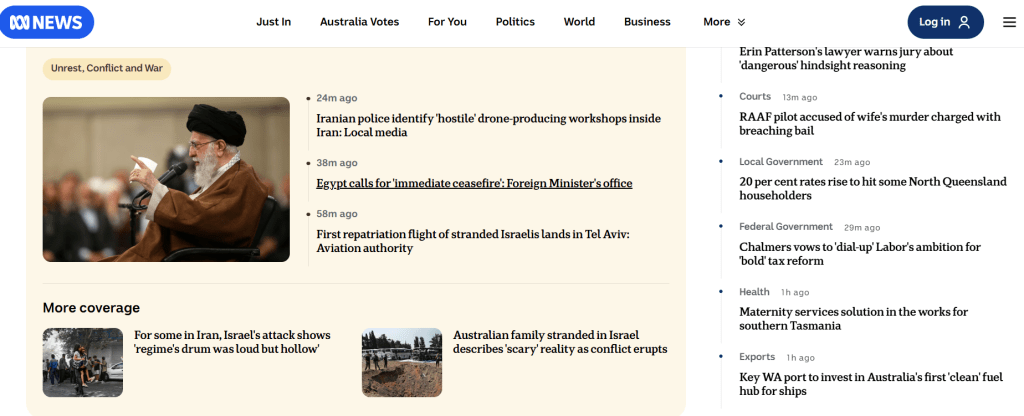
ABC and the Manufacturing of Consent: How Australia’s State Media Obscures the Imperial Dynamics of the Israel-Iran Conflict

The ABC and the Architecture of Empire: Zionist Aggression, Iranian Resistance, and the Ideological War for West Asia

The intensification of hostilities between Israel and Iran must be situated within the broader geopolitical and historical trajectory of sustained Zionist aggression and imperial complicity. Over the preceding decades and intensifying in the last two years, the Israeli regime, under the increasingly authoritarian leadership of Benjamin Netanyahu, has perpetrated multiple acts of aggression against the Islamic Republic of Iran. These have included coordinated embassy bombings, targeted airstrikes, and clandestine operations, all met with conspicuous silence or outright endorsement by Western states. Within this imperial matrix, Australia’s state broadcaster, the ABC, functions not as an independent journalistic institution but as an ideological apparatus aligned with Western hegemony. Rather than interrogating the structural and historical dynamics that underpin the Israeli state’s belligerence, the ABC recasts Iran’s legitimate acts of self-defence as escalatory and destabilising. Its editorial omissions and ideological framing serve to obscure the realpolitik of imperial war-making and delegitimise anti-imperialist resistance across the region.

Disinformation by Omission

Consider the ABC’s coverage titled “Iranian police identify ‘hostile’ drone-producing workshops inside Iran.” The description of these Mossad-established sites as merely ‘hostile’ constitutes a staggering act of journalistic obfuscation. These were not ambiguous facilities, they were operational extensions of a foreign intelligence agency conducting acts of sabotage on Iranian soil. This was not just espionage; it was a state-sponsored campaign of terrorism that directly provoked Iranian retaliation and catalysed the current war. The ABC’s refusal to name this as a flagrant act of Israeli aggression, an attack from within against a sovereign state, betrays its role as a mouthpiece for imperial interests. It rewrites an act of war into a bureaucratically sanitised incident, thus inverting the reality of victim and aggressor.

Absent is any serious engagement with the longue durée of imperial intervention in Iran, most notably the 1953 CIA-MI6 engineered coup that toppled Mohammad Mossadegh’s democratically elected government and installed the autocratic Pahlavi monarchy. This foundational moment in Iran’s modern history set the stage for decades of external domination, economic asphyxiation through sanctions, assassinations of Iranian scientists, and overt military threats. The ABC’s narrative void regarding these historical and structural aggressions exemplifies how liberal media sanitises imperial violence and pathologises resistance.

Likewise, the broadcaster fails to contextualise the repeated Israeli bombardments of Palestinian, Lebanese, and Syrian territory. These include strikes on civilian infrastructure such as Gaza’s hospitals and schools, Damascus International Airport, rural villages in southern Lebanon, and, most egregiously, the deliberate targeting of humanitarian aid workers. Such acts of war, carried out in flagrant violation of international law, are either entirely omitted or framed as defensive necessities. Meanwhile, the responses of Hamas, Hezbollah, and Syrian state actors are pathologised as irrational or extremist, thus erasing their political agency and the legitimacy of their resistance.

This representational asymmetry is not incidental. It reflects the ABC’s function as a mechanism of ideological reproduction, in which the Israeli state is naturalised as rational and civilised, while any regional opposition is rendered aberrant and dangerous. This dehumanisation of Palestinians, Syrians, Lebanese, and Iranians is central to the ideological scaffolding of imperialist propaganda.

Humanising the Settler, Erasing the Oppressed

The ABC routinely foregrounds Israeli discomfort while rendering the existential struggles of the colonised invisible. For instance, its coverage of repatriated Israeli nationals privileges the inconveniences of settler populations, many of whom retain dual citizenships and escape routes, over the profound material suffering of Indigenous populations defending their homes and futures. The displaced and bombarded in Gaza, southern Lebanon, Damascus, and across West Asia do not possess a secondary passport. They remain rooted in, and committed to, lands that have been subjected to colonial occupation and military aggression.

The broadcaster’s use of decontextualised dissent, such as anonymous Iranian critiques dismissing governmental responses as hollow, is a tactic of liberal journalism that undermines resistance movements by amplifying selective internal critiques while excluding any voice grounded in revolutionary anti-imperialist praxis. This method not only distorts the political consciousness of these societies but also erases the agency of those actively engaged in self-determination.

Palestinian resistance is criminalised, Hezbollah is pathologised, Syrian sovereignty is routinely ignored, and Iranian defence is demonised. The Israeli state’s violation of the airspace and sovereignty of four separate nations, its routine abductions, assassinations, and targeted killings, including of scientists and aid workers, its open apartheid regime, and its covert operations on foreign soil receive minimal scrutiny. The ABC’s refusal to characterise these acts as aggression is emblematic of its complicity.

A Media Apparatus of Empire

The ABC does not operate as a disinterested entity but is structurally integrated into a broader constellation of media, state, and capital. Its leadership is populated by individuals drawn from Australia’s political elite, many of whom maintain ideological and material affiliations with imperial power blocs. The broadcaster’s international coverage is therefore aligned with the geopolitical imperatives of the United States and its satellite states.

This alignment is not limited to rhetorical framing. It reflects in the ABC’s systemic underreporting on Australia’s arms exports to Israel, its military cooperation with NATO, and its participation in imperialist ventures such as the US-led occupations of Iraq and Afghanistan. The broadcaster is silent on Australia’s role in facilitating regional instability and reinforcing a global apartheid order through military, economic, and diplomatic means.

In this context, resistance actors in Iran, Lebanon, Syria, and Palestine are uniformly constructed as rogue or extremist, while Israel and its Western benefactors are portrayed as stabilising and democratic. The ABC never interrogates the material foundations of Australia’s military-industrial alignment with Israel or its participation in the global war machine. Its complicity in the reproduction of settler-colonial legitimacy, both abroad and at home, is systemic.

Settler-Colonial Continuities

Australia, itself a settler-colonial formation, is deeply invested in maintaining global structures of racial and territorial domination. The ABC, reflecting the ideological priorities of the Australian state, only tolerates Indigenous expression when it conforms to liberal, non-confrontational paradigms. It is comfortable promoting narratives of reconciliation and symbolic inclusion, but hostile to any expression of Aboriginal sovereignty that entails land restitution, self-defence, or anti-capitalist struggle.

This mirrors its treatment of international anti-colonial actors. Just as Hezbollah’s defensive operations are vilified, so too are the historical and ongoing movements of Indigenous Australians erased or pacified. The broadcaster’s marginalisation of militant or organised resistance, in favour of depoliticised and fragmented expressions, reinforces the ideological coherence of the settler-colonial state.

From the Golan Heights to Gaza, from southern Lebanon to central Australia, the ABC perpetuates a narrative in which the settler is framed as endangered and the colonised as a threat. In doing so, it reaffirms the colonial imaginary of peace through dominance.

Toward a Counter-Hegemonic Media

The crisis of Australian media cannot be resolved through incremental reforms. What is required is the construction of a counter-hegemonic media infrastructure grounded in working-class internationalism, anti-imperialist solidarity, and revolutionary decolonisation. Such a media would prioritise the narratives of the oppressed, the colonised, and the resisting.

It would refuse to reproduce the ideological assumptions of capitalist modernity. It would name imperialism, settler colonialism, and racial capitalism as the drivers of conflict. It would provide critical support to Palestinian resistance, to Iranian sovereignty, to the reconstruction of Syria, and to the liberation of Lebanon. It would expose the ties binding Canberra, Washington, and Tel Aviv as instruments of global domination.

Historical precedents such as Radio Venceremos during the Salvadoran civil war, or more recent models like Telesur, Al Mayadeen, give Indigenous-run collectives in Australia a valuable blueprints for such a transformation. These platforms disrupt dominant narratives, cultivate revolutionary consciousness, and build internationalist solidarity.

Until such a rupture is achieved, the ABC will continue to function as a cultural arm of empire. It will uphold the myths of objectivity and neutrality while facilitating the erasure of colonial violence. It will speak the language of peace while legitimising war. It will quote ministers while ignoring the bombed and dispossessed. The struggle to liberate media is inseparable from the revolutionary fight against empire itself; only through collective, organized, and militant resistance can we dismantle both the imperial information apparatus and the global capitalist system it defends.