The Real Question We’re Not Asking

The question is not whether Australians are okay. The question is why a society organised around insecurity expects people to be okay.

For fifty years, Australian workers have been told the same lie in different language. When factories closed, they were told to retrain. When jobs went offshore, they were told to adapt. When housing became unaffordable, they were told to budget better. When casualisation became normal, they were told flexibility was freedom. Now artificial intelligence arrives, not as liberation from labour, but as another weapon in the hands of capital, and once again the working class is told to be resilient.

This is the central contradiction. Under capitalism, technology does not belong to humanity. It belongs to those who own the means of production. Artificial intelligence could shorten the working week, reduce useless labour, improve public services, and free people from the drudgery of repetitive administrative work. But in the hands of banks, insurers, logistics firms, media companies, universities, consultancies and government departments shaped by the same market logic, AI becomes a machine for labour discipline. It is used to cut jobs, intensify work, suppress wages, deskill professions, eliminate entry-level pathways, and transfer more wealth upward.

That is not a technological problem. It is a class problem.

The ruling class always presents its offensive as progress. Deindustrialisation was called modernisation. Offshoring was called efficiency. Casualisation was called flexibility. Wage suppression was called fighting inflation. The housing crisis was called investment. Now mass automation is called innovation. The language changes, but the material relationship remains the same: capital moves, workers absorb the shock.

This is why the mental-health framing is so dishonest. The system produces anxiety, then sells awareness. It destroys secure work, then hands out wellness posters. It turns homes into speculative assets, then tells renters to practise mindfulness. It ships jobs offshore, imports labour under conditions designed to weaken collective bargaining, automates the remaining office work, and then asks, once a year, “R U OK?”

A Marxist-Leninist analysis has to begin from the material base. Mental distress is not simply an individual illness floating above society. It is shaped by the conditions of life: work, housing, income, family stability, social connection, debt, time, dignity, and power. When millions live one rent rise, one redundancy, one injury, one algorithmic restructuring, or one failed job application away from collapse, widespread anxiety is not a mystery. It is the predictable emotional life of a precarious class.

R U OK? Day is not the cause of this crisis. But it is part of the ideological management of it.

Its function is not merely to encourage care. It also narrows the field of acceptable questions. It asks whether the individual is coping. It does not ask why the workplace is organised in a way that makes people break. It asks whether workers are talking. It does not ask whether they have power. It encourages managers to perform concern while leaving untouched the economic relations that make workers disposable.

This is liberalism at its most polished: compassion without confrontation, awareness without class struggle, conversation without redistribution, kindness without power.

The corporate sponsor loves this model because it costs almost nothing. A yellow cupcake is cheaper than permanent employment. A morning tea is cheaper than a wage rise. A poster is cheaper than reducing workloads. A hashtag is cheaper than stopping redundancies. The employer can appear humane while continuing to do exactly what capital demands: reduce labour costs, maximise productivity, protect profit, and discipline the workforce.

The immigration debate serves a similar ideological function. Workers are encouraged to blame other workers. Australian-born workers are told migrants are the threat. Migrant workers are brought in under insecure conditions and made vulnerable to exploitation. Both groups are then forced into competition for jobs, rentals, services and wages, while the employer class and property-owning class escape scrutiny.

This is not accidental. It is the oldest trick in capitalist politics: horizontal anger to prevent vertical anger.

The issue is not migrant workers. The issue is the class that uses migration policy, labour hire, offshoring, automation, anti-union laws, housing speculation and debt to discipline the entire working class. The Australian worker and the migrant worker have the same enemy when wages are suppressed, rents rise, jobs disappear, and every part of life is subordinated to profit.

The political parties will not seriously confront this because they are managers of the same system. Labor and the Coalition differ in language, tempo and social base, but both accept the rule of capital. Both accept the market as the organising principle of society. Both accept housing as an asset class. Both accept corporate power over production. Both accept that workers must be flexible while capital must be free. Both accept the logic that technology belongs first to owners, not to the people.

That is why the crisis cannot be solved by awareness campaigns or better messaging. The issue is power.

If AI increases productivity, then the working class should receive the benefit through shorter hours, higher wages, stronger public services and guaranteed employment protections. If technology makes certain labour unnecessary, then society should reduce necessary labour for everyone, not throw sections of the population into poverty. If companies use automation developed through publicly funded research, public infrastructure and collective human knowledge, then the gains should be socialised, not privatised.

The demand should not be “manage the transition” while workers are sacrificed again. The demand should be worker control over the transition.

No AI-driven redundancy without union approval. No public subsidies for firms that offshore jobs. No automation windfalls without taxation and redistribution. No corporate sponsorship of mental-health campaigns while companies casualise, automate and sack workers. No housing policy that treats shelter as a casino chip. No labour system that pits local and migrant workers against each other. No wellness theatre in workplaces where the basic conditions of life are being stripped away.

The working class does not need more lectures about resilience. It needs power.

It needs unions willing to organise around AI, housing, casualisation and offshoring as one connected class struggle. It needs political education that names capitalism, not just “cost of living pressures.” It needs public ownership in strategic industries. It needs industrial policy that rebuilds productive capacity. It needs housing treated as a social right. It needs migrant and local workers organised together against the employers who exploit both. It needs a shorter working week without loss of pay. It needs democratic control over technology.

Above all, it needs to reject the lie that this is natural.

There is nothing natural about a society where homes sit empty while workers sleep in cars. There is nothing natural about billion-dollar companies cutting staff while sponsoring mental-health campaigns. There is nothing natural about young people being trained for professions whose entry-level jobs are then automated. There is nothing natural about a worker being told to talk about their feelings while the economic foundation of their life is removed beneath them.

These are not accidents. They are policy choices. They are class choices. They are the consequences of a society built to protect profit before people.

So yes, ask people if they are okay. But do not stop there. Ask why they are exhausted. Ask why their rent consumes their wage. Ask why their job is insecure. Ask why their workplace is understaffed. Ask why the company has money for consultants and sponsorships but not for permanent jobs. Ask why technology that should liberate people is being used to discard them. Ask why the political class discusses migration endlessly but rarely names offshoring, profit, property speculation, union-busting or corporate power.

The real question is not “R U OK?”

The real question is: who made us live like this, who profits from it, and what are we prepared to organise to take back?

Where to Now for Australian Cricket? The Labuschagne Crisis Is Not His Alone

By The Red Gum

Alex Malcolm’s analysis of Marnus Labuschagne is compassionate, well-reported, and fundamentally misleading. Not because the facts are wrong—they are not—but because the frame is inverted. Malcolm asks where Labuschagne goes from here. The correct question is: Where does Australian cricket go from a system that produces this crisis as a routine feature, not a bug?

Let us examine the contradictions Malcolm observes but cannot name.


First Contradiction: The Domestic Miracle That Proves Nothing

Malcolm writes that Labuschagne “was named Australia’s domestic One-Day player of the season with four centuries in six innings” against four different state attacks. He then notes, almost in passing, that the bowlers Labuschagne dominated included part-timers, fringe players, and men with no international future. Twenty-five bowlers were used across those four games. How many would walk into Bangladesh’s current ODI attack? Perhaps none.

Malcolm knows this. He writes that Labuschagne’s domestic dominance “probably says a lot more about the depth of Australia’s white-ball bowling at the moment.” But he refuses to draw the logical conclusion: domestic cricket no longer functions as a reliable proving ground for international batting.

If the gap between domestic and international competition has widened to the point where a man averaging 11.64 across his last 14 international innings can simultaneously score four centuries in six domestic innings, then the domestic pathway is broken. Not shallow. Broken. Sending Labuschagne back to that level would not help him find form. It would merely confirm that he remains excellent against opponents he will never face in an Australia shirt.

The journalist treats this as a puzzle. A materialist treats it as a structural contradiction.


Second Contradiction: The Slump That Cannot Be Named

Malcolm documents the numbers meticulously: since Nottingham, Labuschagne averages 11.64 across 14 ODI innings. In seven ODIs across the last 12 months, he has scored 27 runs off 70 balls. That is not a slump. That is a fundamental breakdown in the relationship between player and level.

Yet Malcolm still writes of Labuschagne being “lost in the wilderness” with the look of a man who “has no idea how he will find his way out.” The language is romantic. It individualizes a collective failure. Labuschagne is not lost. He is being exposed. The difference matters.

A player averaging 11.64 over 14 innings is not having a crisis of confidence. He is demonstrating that the conditions which enabled his 2023 run—specific bowling attacks, specific match situations, specific team roles—no longer obtain. The world has moved. He has not. That is not a tragedy. That is the ordinary logic of sport, visible in every generation of players who burned briefly and then faded.

But Malcolm cannot say this plainly because his project is to keep the question open. Is Labuschagne finished? Might he recover? The uncertainty is the product. Certainty would end the article.


Third Contradiction: The Run Out as Symptom

The description of Labuschagne’s run out in Lahore is the article’s most revealing passage. Malcolm writes that Labuschagne was “so desperate to do the right thing that he’s committing self-sabotage.” He notes that captain Josh Inglis “failed to recognise the head space” his partner was in.

This is presented as a failure of communication. A materialist reads it as a failure of structure.

Two batters sharing a crease are not just two individuals. They are positions in a batting order, each with assigned functions. Inglis’s function is to score freely. Labuschagne’s function is to accumulate steadily. When the steady accumulator can no longer accumulate, the entire order distorts. Inglis becomes starved of strike. Labuschagne, feeling the pressure of his own non-performance, attempts a run that no confident batter would attempt. The run out is not bad luck. It is the inevitable collision of two incompatible material realities.

Malcolm calls it a “mix-up.” That is like calling a factory collapse a clumsy placement of bricks.


Fourth Contradiction: The Selectors Who Cannot Select

Malcolm reports that Labuschagne was dropped from the Test team as a “circuit-breaker” but has been retained in ODIs through an even longer slump. He offers no explanation for this inconsistency because he has no theory of selection.

Here is a theory: selection in Australian cricket is not a science but a practice of unaccountable power.

There are no published criteria for selection or deselection. There is no independent review. There is no mechanism by which a state batter averaging 50 in domestic cricket can demand an explanation for why Labuschagne continues to play while averaging 11.64 internationally. The selection bureaucracy is accountable to no one but itself.

Malcolm writes that selectors are “grappling with what to do with him.” Grappling. The word suggests honest struggle. But what is there to grapple with? A man with 14 consecutive poor innings, with a single half-century in two-and-a-half years, with a century drought across 70 international innings across all formats. If that player is not dropped, then the word “selection” has no meaning.

The only explanation for Labuschagne’s continued presence is reputation capital: the 2023 World Cup final innings, the Test centuries of 2022-23, the memory of a player who no longer exists. Selectors are not backing current performance. They are backing a ghost.


Fifth Contradiction: The Journalist’s Own Position

Malcolm cannot see these contradictions because his position prevents him. He is embedded within the very system he reports on. His sources are selectors, coaches, and senior players. His publication is a commercial enterprise that depends on access to those same figures. His audience is a public that has been taught to think of cricket in individual terms—heroes, slumps, comebacks, tragedies.

To write the article that the facts demand, Malcolm would have to name names. He would have to say: The selection panel is failing in its basic duty. The domestic pathway is not fit for purpose. Labuschagne should have been dropped ten innings ago, and the only reason he has not been is the cowardice of those who selected him originally and refuse to admit error.

He cannot write that article. So he writes this one instead: sympathetic, detailed, intelligent, and ultimately useless. It describes the crisis beautifully. It explains nothing.


Conclusion: Where to Now for Australian Cricket?

The Labuschagne crisis will end one of three ways. He will suddenly find form (unlikely, given the depth and length of the slump). He will be dropped (likely, eventually). Or he will retire or be moved on after the next World Cup cycle (possible).

None of these outcomes will resolve the underlying contradictions. The next batter who dominates a weakened domestic competition will be selected. The next slump will be managed with the same inconsistent, unaccountable, reputation-based logic. The next journalist will write the same sympathetic article asking where it all went wrong.

A materialist analysis offers one prescription: transparency, accountability, and consistency in selection. Published criteria. Independent review. A formal mechanism by which the gap between domestic and international performance is measured and acted upon.

Without those changes, the system will continue to produce players like Labuschagne: celebrated, overexposed, broken, and discarded, with each stage treated as a personal drama rather than a predictable outcome of structural failure.

Labuschagne is not the problem. He is the symptom. Australian cricket will keep producing the symptom until it treats the disease.

In reply to: https://www.espncricinfo.com/story/where-to-now-for-australia-batter-marnus-labuschagne-1540358

When opportunity knocks, Parliament moves in hours. When you are overcharged for bread, take a number.

Seven hours and twenty-five minutes.

That is how long it took the Australian Parliament to terminate the Russian Federation’s lease on a block of land near Parliament House in June 2023. The House passed the bill in four and a half minutes. The Senate in three. By 4:26 pm that same day, it was law.

I mention this not because I object to national security measures. I mention it because this single event proves, beyond any doubt, that the political system can move at extraordinary speed when it decides something matters.

But here is what else it proves: the system does not only move when it is threatened. It also moves when there is something to gain.

The speed of opportunity

Let me be precise about what the system can do when it is properly motivated.

During the COVID-19 pandemic, governments imposed sweeping controls on movement, work, and social life without prior parliamentary approval. Borders closed. Businesses shut. Communities were confined. The executive acted. Parliament rubber-stamped the decisions later. You could call that a response to crisis. Fair enough.

But consider what happened in 2025.

Parliament was recalled within 48 hours to pass hate speech laws in response to the Bondi terror attack. A tragedy occurred. Public fear was high. The mood was raw. And into that window, the government rushed laws that had been sitting in draft form for months—laws that criminalised speech, expanded police powers, and gave the state new tools to silence dissent. All under the cover of “safety.”

This was not a response to a threat to the powerful. The powerful were not at risk. This was an opportunity—a chance to expand state power, to criminalise political opponents, to emerge from a tragedy with more control than before. And Parliament moved at the speed of light to seize it.

Electoral laws—the most significant changes to how democracy functions in 40 years—were rushed through both Houses in a single day after a late-night deal between the major parties. The Senate was expected to debate the bill without even seeing the amendments. Again, an opportunity: both parties saw a chance to lock in the two-party system and shut out independents. They took it.

The message is unmistakable: When the powerful see an opening—a crisis to exploit, a tragedy to weaponise, a deal to strike—the political system moves at the speed of light.

The pace of protection for ordinary people

Now contrast this with the timeline for protecting ordinary Australians from being systematically overcharged by supermarkets—a harm that affects every single person in this country, every single week.

Legislation that would give regulators stronger powers to crack down on corporations that harm consumers passed the House of Representatives before the federal election in May 2025. It had to be reintroduced in August 2025 to “finish the job.” Consumer advocates had been calling for these powers for years. Years.

The Scams Prevention Framework—legislation designed to protect Australians from the billions of dollars lost to fraud—was left to the final weeks of the parliamentary sitting. Consumer groups called for Australia to follow the United Kingdom’s model of mandatory compensation within days. Instead, the proposed framework means a complaint “may take up to two years to resolve.”

Two years. The fraudsters will have stolen billions more in that time.

And the issue that sits at the heart of the Woolworths case—the vague, judicially-unworkable definition of what constitutes a genuine “was/now” price in supermarket promotions? That has been sitting in the too-hard basket for years. No one has treated it as urgent. No one has recalled the House to fix it overnight.

Why the double standard exists

If you want to understand why the system can move overnight on some things but not on others, follow the opportunity.

The Russian lease? No organised opposition. No industry group had a financial stake in preserving it. No lobbyists made phone calls. No campaign donations were threatened. The opportunity to look tough on Russia? Priceless. Parliament moved.

The Bondi hate speech laws? The opportunity to expand state power while appearing to protect the public? Irresistible. Parliament moved.

Electoral reform? The opportunity for both major parties to entrench the two-party system and freeze out independents? A deal was struck before dawn. Parliament moved.

Now consider consumer protection.

The opportunity to help ordinary people at the expense of powerful corporations? That opportunity exists every single day. Every voter is a consumer. Every family buys groceries. Every person in this country has been overcharged at some point. A government could rush through a law defining “reasonable period” as 60 days. They could campaign on it. They could win votes on it.

They do not.

Not because the opportunity is absent. Because the wrong people would benefit.

The people who would gain from clear, enforceable consumer protection laws are ordinary Australians. And ordinary Australians do not make campaign donations. They do not offer lucrative post-politics jobs. They do not run media campaigns in support of friendly MPs.

The people who would lose from clear consumer protection laws are the supermarket duopoly—Woolworths and Coles—and the broader corporate sector. They do make donations. They do offer jobs. They do run campaigns.

So the opportunity sits untouched. Year after year. Parliament after Parliament.

What this means for the Woolworths case

Let me return to where this began.

Justice O’Bryan is currently wrestling with a question that Parliament should have answered years ago: What is a “reasonable period” for a “was” price?

The consumer watchdog says a few weeks is not enough. Woolworths says 19 days is fine. The judge is left to guess, because the law does not specify.

Parliament could fix this tomorrow. Literally tomorrow. If a Russian lease can be terminated in seven hours—if hate speech laws can be drafted and passed in 48 hours—a definition of “reasonable period” could be added to the Competition and Consumer Act by lunchtime.

But it will not happen. Not because it is technically difficult. Not because there is no agreement that consumers are being misled. But because the supermarket duopoly has no interest in a clear rule. Vague laws benefit the party with more lawyers.

And because protecting ordinary people from routine, predictable exploitation is not an opportunity that the political class wants to seize. No single overpayment for laundry powder or biscuits is worth a national news cycle. But millions of overpayments, aggregated over years, becomes a quiet transfer of wealth from people who need it to companies that do not.

That transfer is not a bug in the system. It is a feature. And the people who benefit from it are the same people who fund the political campaigns that keep the laws vague.

The real crisis

The Centre for Public Integrity released a report in early 2026 finding that “rushed, opaque or selective law-making processes risk poorer-quality laws, increase the likely influence of vested interests and further erode already fragile public trust in political institutions.”

They were talking about hate speech laws. But the observation applies more broadly.

The system can act with breathtaking speed when it wants to—when there is an opportunity to expand state power, to entrench the two-party system, to look tough on Russia. But when the opportunity is to help ordinary people at the expense of powerful corporations? Suddenly, everything slows down. Consultation is required. Stakeholders must be heard. Change cannot happen overnight.

The question Australians should be asking is not whether Parliament can pass consumer protection laws quickly.

It is why it consistently chooses not to.

The answer is uncomfortable. But it is not complicated.

The system does not serve the people who need it. It serves the people who can afford it. And the people who can afford it have no interest in clear, enforceable rules that would stop them from quietly transferring wealth from your pocket to theirs.

So the judge will keep wrestling with vague laws. Woolworths will keep winning. And you will keep overpaying.

Not because the system is broken.

Because the system is working exactly as it was designed to.

This is in repsonse to the following ABC article: https://www.abc.net.au/news/2026-04-30/tense-exchanges-federal-court-case-accc-woolworths/106561702

The Fifth Element Isn’t Subversive; It’s a Neon Mirage of the Status Quo


Luc Besson’s The Fifth Element (1997) is often celebrated as a fun, irreverent sci-fi classic. Bold colours, wacky characters, space priests, and a world teetering on the edge of collapse. But underneath the glittering surface is a film that doesn’t challenge power. It reinforces it. Its supposed weirdness masks a deeply conventional structure: elite saviours, cartoon villains, helpless masses, and a universe that has already decided who gets to rule and who gets to beg for salvation.

This isn’t a vision of freedom. It is cultural anaesthetic.


Escapism as a Cage

The film gives the impression of critique. The world is polluted, overpopulated, and mired in bureaucracy. But that dystopia is dressed up in such absurdist flair that it becomes entertaining, even comforting. The future may be broken, but it is never threatening because it is so colourful, so exaggerated, so far removed from our material lives.

This is how culture pacifies. It shows us a grotesque version of reality so we can laugh at it rather than question it. The cops are brutal but funny. The government is clueless but lovable. Dystopia is framed as quirky, a distraction rather than a warning.


The Fantasy of Individual Salvation

Korben Dallas, played by Bruce Willis, is sold as a “man of the people,” an ex-soldier turned cabbie. But everything about him screams elite fantasy. He doesn’t fight with anyone. He fights for everyone. Alone. No comrades, no collective struggle. He is a chosen one.

Then there is Leeloo, the so-called “perfect being.” Manufactured in a lab, spoken about like a weapon, dressed like a lingerie model. She is a literal object, talked about, pursued, and “protected” by men. Her transformation isn’t political or conscious. It is emotional and romantic. She is powerful only once she learns to love a man. That is her awakening.

This is what passes for empowerment. A woman who exists to be saved so she can then save the world. No rebellion. No refusal. Just submission in exchange for significance.


Class, Race, and the Invisible Order

There is no meaningful working class in The Fifth Element. The poor are background noise: criminals, beggars, or irritants. There are no unions, no movements, no ordinary people taking charge of their future. The only people with agency are exceptional: soldiers, priests, scientists, billionaires, aliens, or freaks.

The film borrows aesthetics from all over the world: Black flamboyance, Asian street food, alien tribalism. But all of it is there for decoration. Culture becomes costume. Ruby Rhod, played by Chris Tucker, is outrageous, hilarious, and completely marginalised. A joke, not a threat. The world may be “diverse,” but the saviours are still white.

And the villain? Zorg, played by Gary Oldman, is a capitalist arms dealer. But his villainy is treated as a personal failing. He is not the product of a class. His defeat doesn’t change anything. It is theatre.


War, State Power, and the Fog of Evil

The biggest enemy in The Fifth Element is a giant ball of evil in space. There is no origin, no political root, no historical cause. Just an abstract “darkness” that must be defeated by a handful of experts and military personnel. The people don’t rise up. They are not even asked to. The state is clumsy, paternal, oddly charming, and still runs the show.

This is how stories bury power. By turning evil into something metaphysical, they erase the real sources of suffering: exploitation, inequality, colonialism, war. Instead of confronting the systems that shape our world, we are told the danger comes from somewhere else. Something unknowable. Something only the elites can handle.


A Shiny Reboot of the Same Old Lies

The Fifth Element entertains, but it is a nostalgia trip for the world as it is. It dresses up oppression in neon and latex, sells us patriarchy as destiny, and drowns real questions in camp humour and spectacle. It doesn’t liberate, it doesn’t ask for progress or new ideas. It sedates.

The message is clear:
Let the chosen few handle things.
Don’t worry about class, race, or power. That’s too messy.
Just believe in finding the one, trust the system, and enjoy the ride.

We reject that. We believe culture should challenge power, not flatter it. Stories should stir action, not obedience. The future isn’t something to be saved by elites. It is something to be built by all of us, together.

ABC and the Manufacturing of Consent: How Australia’s State Media Obscures the Imperial Dynamics of the Israel-Iran Conflict

The ABC and the Architecture of Empire: Zionist Aggression, Iranian Resistance, and the Ideological War for West Asia

The intensification of hostilities between Israel and Iran must be situated within the broader geopolitical and historical trajectory of sustained Zionist aggression and imperial complicity. Over the preceding decades and intensifying in the last two years, the Israeli regime, under the increasingly authoritarian leadership of Benjamin Netanyahu, has perpetrated multiple acts of aggression against the Islamic Republic of Iran. These have included coordinated embassy bombings, targeted airstrikes, and clandestine operations, all met with conspicuous silence or outright endorsement by Western states. Within this imperial matrix, Australia’s state broadcaster, the ABC, functions not as an independent journalistic institution but as an ideological apparatus aligned with Western hegemony. Rather than interrogating the structural and historical dynamics that underpin the Israeli state’s belligerence, the ABC recasts Iran’s legitimate acts of self-defence as escalatory and destabilising. Its editorial omissions and ideological framing serve to obscure the realpolitik of imperial war-making and delegitimise anti-imperialist resistance across the region.

Disinformation by Omission

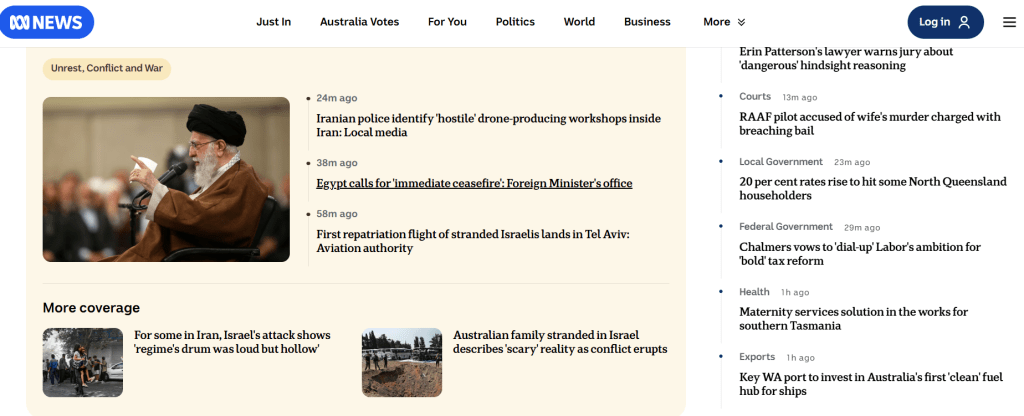
Consider the ABC’s coverage titled “Iranian police identify ‘hostile’ drone-producing workshops inside Iran.” The description of these Mossad-established sites as merely ‘hostile’ constitutes a staggering act of journalistic obfuscation. These were not ambiguous facilities, they were operational extensions of a foreign intelligence agency conducting acts of sabotage on Iranian soil. This was not just espionage; it was a state-sponsored campaign of terrorism that directly provoked Iranian retaliation and catalysed the current war. The ABC’s refusal to name this as a flagrant act of Israeli aggression, an attack from within against a sovereign state, betrays its role as a mouthpiece for imperial interests. It rewrites an act of war into a bureaucratically sanitised incident, thus inverting the reality of victim and aggressor.

Absent is any serious engagement with the longue durée of imperial intervention in Iran, most notably the 1953 CIA-MI6 engineered coup that toppled Mohammad Mossadegh’s democratically elected government and installed the autocratic Pahlavi monarchy. This foundational moment in Iran’s modern history set the stage for decades of external domination, economic asphyxiation through sanctions, assassinations of Iranian scientists, and overt military threats. The ABC’s narrative void regarding these historical and structural aggressions exemplifies how liberal media sanitises imperial violence and pathologises resistance.

Likewise, the broadcaster fails to contextualise the repeated Israeli bombardments of Palestinian, Lebanese, and Syrian territory. These include strikes on civilian infrastructure such as Gaza’s hospitals and schools, Damascus International Airport, rural villages in southern Lebanon, and, most egregiously, the deliberate targeting of humanitarian aid workers. Such acts of war, carried out in flagrant violation of international law, are either entirely omitted or framed as defensive necessities. Meanwhile, the responses of Hamas, Hezbollah, and Syrian state actors are pathologised as irrational or extremist, thus erasing their political agency and the legitimacy of their resistance.

This representational asymmetry is not incidental. It reflects the ABC’s function as a mechanism of ideological reproduction, in which the Israeli state is naturalised as rational and civilised, while any regional opposition is rendered aberrant and dangerous. This dehumanisation of Palestinians, Syrians, Lebanese, and Iranians is central to the ideological scaffolding of imperialist propaganda.

Humanising the Settler, Erasing the Oppressed

The ABC routinely foregrounds Israeli discomfort while rendering the existential struggles of the colonised invisible. For instance, its coverage of repatriated Israeli nationals privileges the inconveniences of settler populations, many of whom retain dual citizenships and escape routes, over the profound material suffering of Indigenous populations defending their homes and futures. The displaced and bombarded in Gaza, southern Lebanon, Damascus, and across West Asia do not possess a secondary passport. They remain rooted in, and committed to, lands that have been subjected to colonial occupation and military aggression.

The broadcaster’s use of decontextualised dissent, such as anonymous Iranian critiques dismissing governmental responses as hollow, is a tactic of liberal journalism that undermines resistance movements by amplifying selective internal critiques while excluding any voice grounded in revolutionary anti-imperialist praxis. This method not only distorts the political consciousness of these societies but also erases the agency of those actively engaged in self-determination.

Palestinian resistance is criminalised, Hezbollah is pathologised, Syrian sovereignty is routinely ignored, and Iranian defence is demonised. The Israeli state’s violation of the airspace and sovereignty of four separate nations, its routine abductions, assassinations, and targeted killings, including of scientists and aid workers, its open apartheid regime, and its covert operations on foreign soil receive minimal scrutiny. The ABC’s refusal to characterise these acts as aggression is emblematic of its complicity.

A Media Apparatus of Empire

The ABC does not operate as a disinterested entity but is structurally integrated into a broader constellation of media, state, and capital. Its leadership is populated by individuals drawn from Australia’s political elite, many of whom maintain ideological and material affiliations with imperial power blocs. The broadcaster’s international coverage is therefore aligned with the geopolitical imperatives of the United States and its satellite states.

This alignment is not limited to rhetorical framing. It reflects in the ABC’s systemic underreporting on Australia’s arms exports to Israel, its military cooperation with NATO, and its participation in imperialist ventures such as the US-led occupations of Iraq and Afghanistan. The broadcaster is silent on Australia’s role in facilitating regional instability and reinforcing a global apartheid order through military, economic, and diplomatic means.

In this context, resistance actors in Iran, Lebanon, Syria, and Palestine are uniformly constructed as rogue or extremist, while Israel and its Western benefactors are portrayed as stabilising and democratic. The ABC never interrogates the material foundations of Australia’s military-industrial alignment with Israel or its participation in the global war machine. Its complicity in the reproduction of settler-colonial legitimacy, both abroad and at home, is systemic.

Settler-Colonial Continuities

Australia, itself a settler-colonial formation, is deeply invested in maintaining global structures of racial and territorial domination. The ABC, reflecting the ideological priorities of the Australian state, only tolerates Indigenous expression when it conforms to liberal, non-confrontational paradigms. It is comfortable promoting narratives of reconciliation and symbolic inclusion, but hostile to any expression of Aboriginal sovereignty that entails land restitution, self-defence, or anti-capitalist struggle.

This mirrors its treatment of international anti-colonial actors. Just as Hezbollah’s defensive operations are vilified, so too are the historical and ongoing movements of Indigenous Australians erased or pacified. The broadcaster’s marginalisation of militant or organised resistance, in favour of depoliticised and fragmented expressions, reinforces the ideological coherence of the settler-colonial state.

From the Golan Heights to Gaza, from southern Lebanon to central Australia, the ABC perpetuates a narrative in which the settler is framed as endangered and the colonised as a threat. In doing so, it reaffirms the colonial imaginary of peace through dominance.

Toward a Counter-Hegemonic Media

The crisis of Australian media cannot be resolved through incremental reforms. What is required is the construction of a counter-hegemonic media infrastructure grounded in working-class internationalism, anti-imperialist solidarity, and revolutionary decolonisation. Such a media would prioritise the narratives of the oppressed, the colonised, and the resisting.

It would refuse to reproduce the ideological assumptions of capitalist modernity. It would name imperialism, settler colonialism, and racial capitalism as the drivers of conflict. It would provide critical support to Palestinian resistance, to Iranian sovereignty, to the reconstruction of Syria, and to the liberation of Lebanon. It would expose the ties binding Canberra, Washington, and Tel Aviv as instruments of global domination.

Historical precedents such as Radio Venceremos during the Salvadoran civil war, or more recent models like Telesur, Al Mayadeen, give Indigenous-run collectives in Australia a valuable blueprints for such a transformation. These platforms disrupt dominant narratives, cultivate revolutionary consciousness, and build internationalist solidarity.

Until such a rupture is achieved, the ABC will continue to function as a cultural arm of empire. It will uphold the myths of objectivity and neutrality while facilitating the erasure of colonial violence. It will speak the language of peace while legitimising war. It will quote ministers while ignoring the bombed and dispossessed. The struggle to liberate media is inseparable from the revolutionary fight against empire itself; only through collective, organized, and militant resistance can we dismantle both the imperial information apparatus and the global capitalist system it defends.